Ox’s Guide to Winter Airsoft
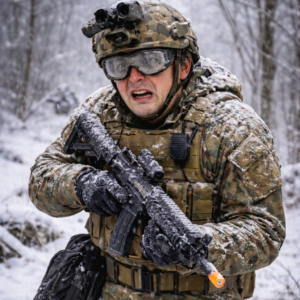
So you think you’re a hardcore airsofter do you? You hit every game when the weather is warm, your kit is dialed, your gun works well and you storm the other teams bases like a champ. Then you hit your first winter game and before it’s even started your standing in the staging area with frozen fingers and toes, your goggles are fogged up and your airsoft gun sounds like it’s hard night of partying and is coughing up lung butter with every shot. Welcome to winter airsoft.
There is something special about playing in the winter, it’s a challenge, it’s hard, and it separates the casual chairsofters from the diehards and bb addicts. The players that show up when the ground is covered in snow and the temps are below freezing, want to be there, they’ve made the commitment, the extra preparation, and you’ve decided to give it a go and join them. Good on ya, let’s make your first winter game a success.
Layering.
The fundamental challenge of winter airsoft is temperature regulation. You’re going to heat up fast when you’re moving and engaging, then cool down rapidly the moment you post up or head back to staging. Your body can’t decide if you’re working out or freezing, and if you don’t dress right, you’re going to be miserable.
The solution is a proper layering system. Not just throwing on a puffy jacket and hoping for the best, but a strategic approach that keeps you comfortable and effective throughout the day.
Layering Rule number one, cotton is your enemy, wool or synthetic are your friends. Cotton holds moisture (sweat), moisture freezes, you get cold. No problem when you’re moving, but when you stop you suffer. Good merino wool or synthetic materials pull moisture off your body (wicking) and shed and dry that moisture faster so when you stop moving, you don’t start freezing.
I personally break layering into 3 parts, base, insulation and outer. From here I can adjust, add remove or adapt depending on my activity and the environment. Check out the US Army’s ECWCS chart (Extreme Cold Weather Combat System). It’s good equipment and can usually be picked up inexpensively as a starting point.
Base layer – synthetic or merino wool. This is your primary insulation and wicking. If you’re going to invest, do it here. I’ve been experimenting with the mesh wool baselayers the past 2 years and there is no going back, they are absolutely incredible. I have a couple different pairs of different weights, light weight for milder and heavy weight for colder and both for extreme cold.
Insulation layer – this is an optional and removeable layer, typically for the top, that you can tailor for your needs. You can get puff insulation, or you can get thermal fleece insulation, both are good options, but make sure it’s packable so you can store it when you’re moving and put it on when you’re going to be posted up or stationary for a while.
Outer layer – this is the protective layer that keeps the wind, rain, snow and wet from soaking you from the outside. Remember your battling moisture, and you’re generating a pile from the inside so a good shell will help reduce the moisture battle. You can get a lined (fleece) outer layer, but they can be bulky and you can’t layer it as well as a strict shell. I prefer a thin shell and do all my insulation with layers underneath so I can adapt as temps and activity changes.
Don’t forget about your fingers and toes. Layer your gloves if necessary, thermal liner and outer waterproof shell, but not too big so you can still use your trigger. Wool (not cotton) socks, and good warm boots will help keep your toes toasty. Some even opt for over boots depending on how cold it is.
The Fog of war.
Eyewear can be a huge challenge during the winter. You’re breathing hard, warm breath, on cool lenses equal fog. I’m sure I don’t have to tell you how useful of a teammate you are when you’re fogged up and can’t see.
You can try anti fog sprays and drops, they work for a bit, and only under prime circumstances. Thermal lens and well ventilated googles help. If you block off the bottoms to keep your breath from hitting the lens and allow the air to move out the top that can help.
The ultimate solution is get some fan goggles or a fan unit and generate some airflow to eliminate the fog. This has been a winter game changer for me and fogging is a thing of the past. If I do fog up, I engage the fan and fog is gone and I’m back in the game. An added expense, but well worth it if your playing during the off season.
Your airsoft gun.
So here’s a quick physics lesson for you. Metal and plastic get brittle in the cold, rubber gets hard, gas doesn’t expand and batteries loose performance. All of this creates challenges.
First, metal and plastic gets brittle. This means things break easier. We all know airsoft guns are not always made from quality materials, so internal or external parts are more prone to breaking and failure in the cold. Not much you can do, just be aware.
Rubber buckings get hard in the cold and this affects hop up. A few shots and the friction of the bb will warm up the patch, or try silicone bucking or cold weather specific buckings.
Green gas is pretty much a no go in the winter, you can try red or black gas as they are designed for colder weather, but really your AEG is your winter time friend. I’m experimenting with HPA this winter, but keep going back to my trusty electric steed.
Batteries loose performance in the cold, this is why your gun sounds like somebody lubed your gearbox with molasses when your shooting it in the cold. Lipo / Lion batteries suffer a little less in the cold, but still feel the effects. Keep a spare inside your jacket so it’s stays warm and is ready to swap out if your primary goes down.
Other considerations
Hydration often gets overlooked in cold weather, but you’re still sweating under those layers and breathing hard. Dehydration affects your performance and decision-making. A thermally protected water bottle or bladder will keep you drinking and staying hydrated during the day.
Snow transforms the terrain in ways that aren’t always obvious. That clear field from summer now hides roots, holes, and obstacles that can cause injuries. Move deliberately, especially when running through areas you’re not familiar with. A twisted ankle ends your day and potentially your season.
Shorter daylight hours compress your playing time significantly. By mid-afternoon, light conditions start deteriorating, and games feel rushed. Pack a light so if you get caught in the dark you can find you way back to the safe area.
Final Thoughts
Winter games attract a specific type of player – those who are committed to the sport and the community. When you show up on a cold February morning, you know everyone else there is equally dedicated. This creates a different atmosphere than summer games. There’s a shared understanding that we’re all choosing to be here despite the challenges. Winter airsoft isn’t for everyone, and that’s okay. It requires extra preparation, better gear maintenance, and a willingness to be uncomfortable at times. But for those who embrace it, winter games offer something special – tighter community bonds, personal growth as a player, and the satisfaction of pushing through challenges.
The snow crunching under your boots, the visible breath in the air, the crispness of winter light through the trees – there’s an atmosphere to winter games that summer can’t replicate. When you land a good shot in challenging conditions, both you and the player you hit share a moment of mutual respect. We’re all out here choosing to do something difficult because we love this sport.
If you’re considering trying winter airsoft, start with a mild day and build from there. Talk to experienced winter players at your field – you’ll find they’re eager to share knowledge and help newcomers succeed. Our community grows stronger when we support each other through the challenging seasons.
Stay warm, maintain your gear, support your fellow players, and most importantly – call your hits. Winter airsoft is about more than just the game; it’s about proving to yourself that you’re committed to this sport and this community year-round. See you on the field. Ox out.